Showing posts with label star trek plants. Show all posts

01-13-2017—Plants of Star Trek (Part 3)

Welcome to planet ouch
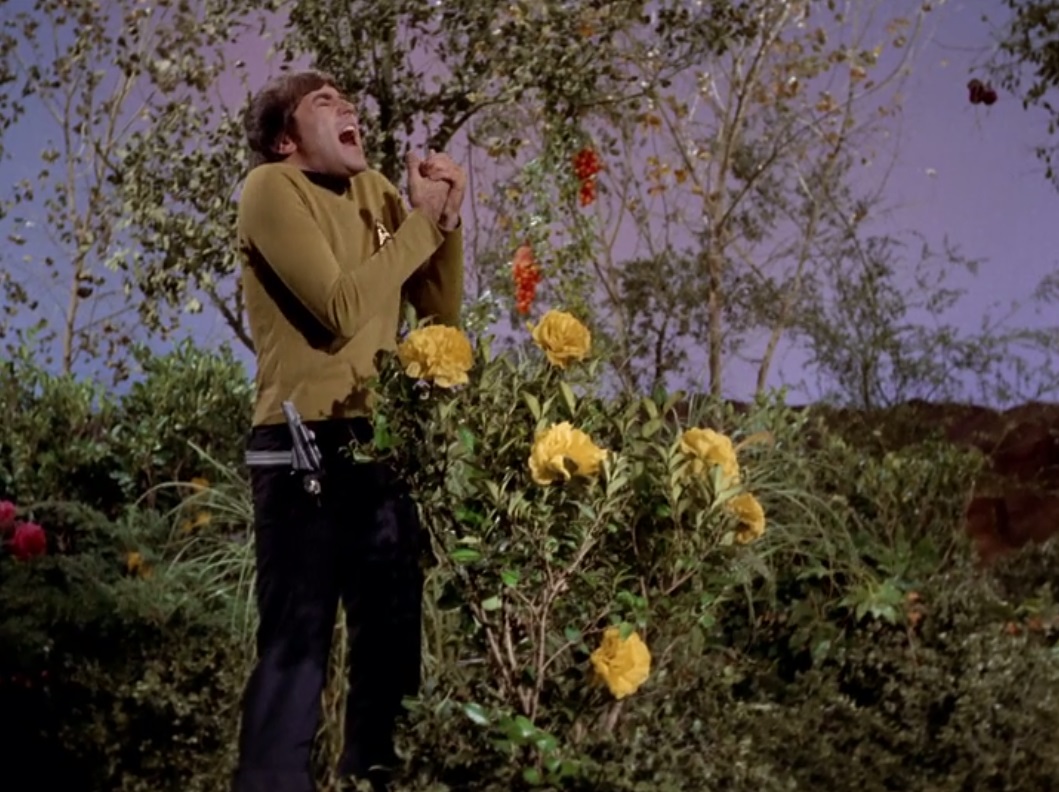
Ensign Chekov grabbing acid burnt hand in pain
In The Way to Eden (S3E20), the Enterprise is hijacked by a madman-scientist and his hippie followers. The culprits flee to a Romulan planet to set up a hippie commune, only to be foiled by the indigenous plants—flesh-burning flowers and poisonous fruits.

What blows my mind is that organisms can contain harmful chemicals for defense without succumbing to damage themselves. For example, some plants contain psoralen, which causes sun rash (phytophotodermatitis). Psoralens are activated by light and bind to DNA, inducing rapid cell death. Notice ACTIVATED BY LIGHT!

Plants are quintessential beings of light. In fact, plants can be harmed by their own psoralens. They combat self-damage by producing other compounds, like flavonoids, to quench photosensitization reactions that would otherwise wreak internal havoc. (Secondary Plant Products Causing Photosensitization in Grazing Herbivores: Their Structure, Activity and Regulation)
Close-up of acid burnt hand phytophotodermatitis
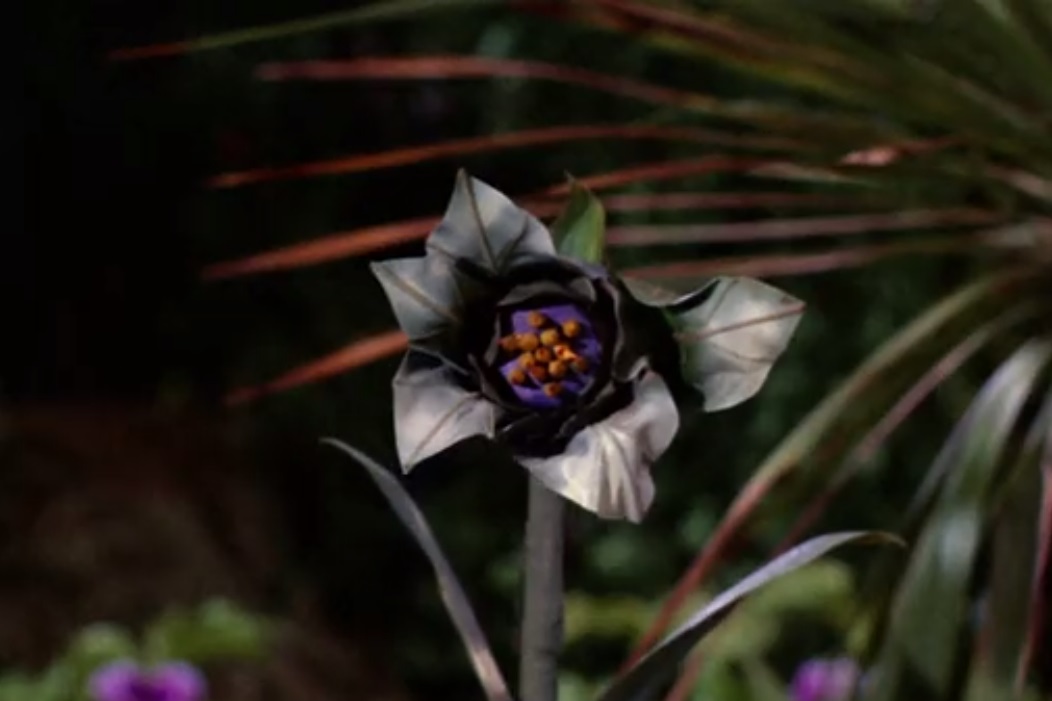
Alien flower burn left, phytophotodermatitis right

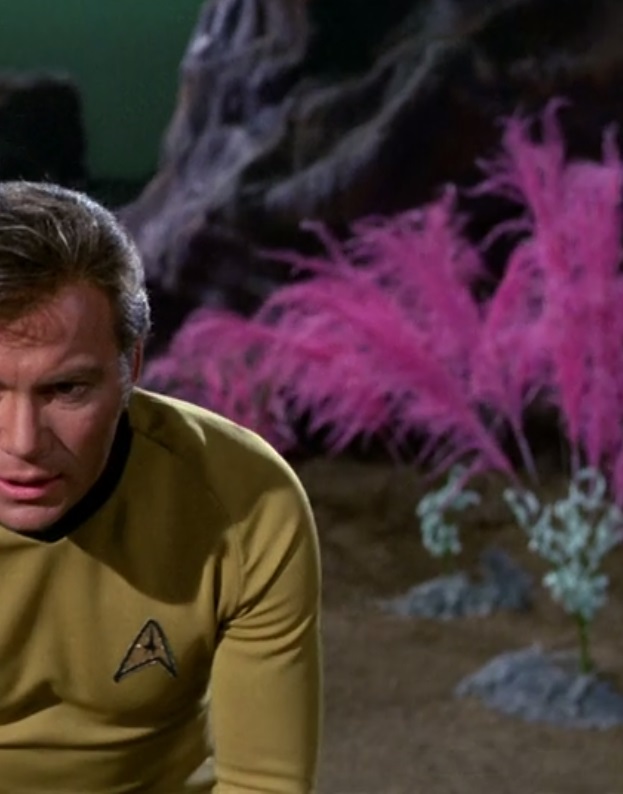
Earth roses don't contain psoralen. See species in Apiaceae and Rutacea families, like wild parsnip and citrus. The extraterrestrial plant pictured above looks suspiciously rose-like, but with, perhaps, a psoralen kick instead of thorns to discourage predators. I would totally grow that in my garden...

In the front yard.
By a walkway.
Because I'm diabolical like that!


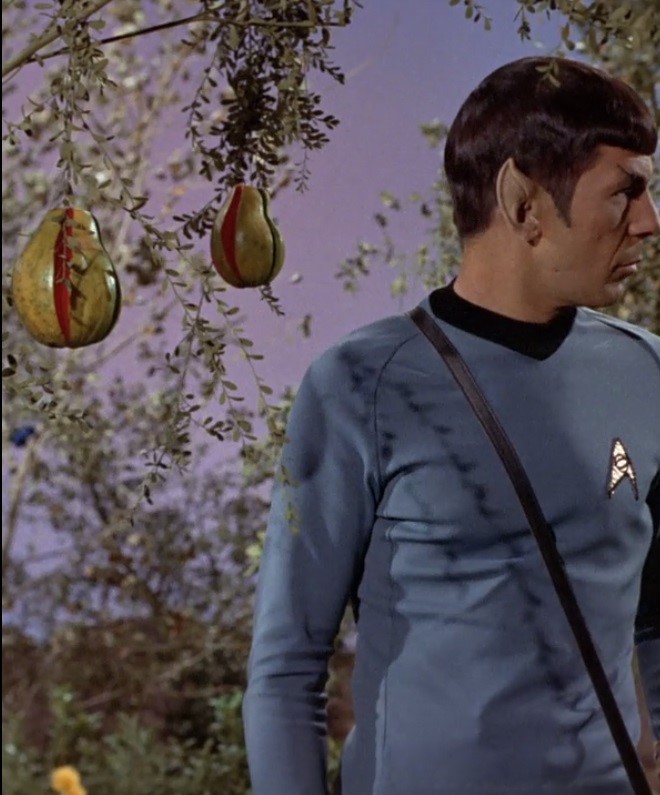
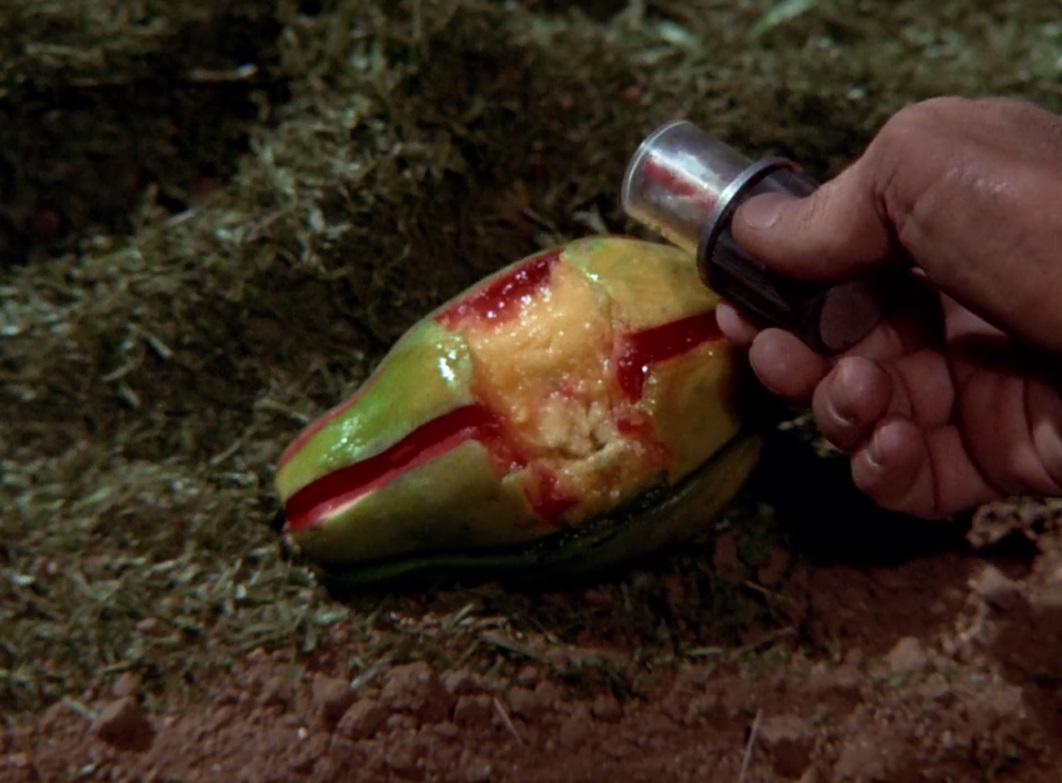
A pear crossed with Smucker's Goober. A Poober.
Spock stands near alien pear tree
Alien pear with bite mark Smucker's Goober
Poison or no, ornamental value is A+.

Dead madman-scientist with alien pear missing a bite
Et tu, Poober?

--------------------------------------
Go to Plants of Star Trek (Part 1)
Go to Plants of Star Trek (Part 2)

08-20-2016—Plants of Star Trek (Part 2)

In The Apple (S2E5), USS Enterprise landing party arrives at an alien planet that is a Garden of Eden, or so it seems. Á la sci-fi formula, Eden is actually a thinly veiled dystopia, housing extreme natural perils, including poison dart shooting flowers. A question comes to mind, what evolutionary benefit would plants gain from killing people at a distance? Carnivorous plants, for example, kill up-close and absorb the nutrients through their leaves. Perhaps the alien plant's strategy is to enrich the soil with rotting corpses, and absorb the nutrients the old fashioned way, through its roots. This strategy would require a lot of carnage to adequately enrich so many cubic feet of soil.

A plant's gotta do what a plant's gotta do.

Dart shooting alien flower
Maybe the flower's gunmetal coloring should've been a clue. But with such an intriguing specimen, who wouldn't come in for a closer look?

Alien flower surrounded by a cloud of smoke
Cloud of pollen as poison darts are ejected.

Star Trek ensign shot with alien flower darts
Darts pierce chest of unsuspecting victim. R.I.P. Ensign Redshirt.

Although unsimilar in appearance, Urtica dioica (stinging nettle) is a good structural analog to this Star Trek creation. Nettles have hypodermic needle-like hairs that inject poison on contact, and the stamens of male flowers pop out when mature and fling pollen to be transported by the wind. Here is a video of U. dioica shooting pollen with funny sound effects.
Urtica dioica flower shooting pollen

I've read some articles hypothesizing that nettles have adapted to wind pollination because the stinging hairs repel potential pollinators. This might be true for grazing mammals, but nettles are host to many non-mammalian visitors, including slugs and butterfly larvae. It's unknown to what extent the stinging hairs actually deter insect species (Genecological Studies of Urtica dioica). Wind pollination in nettles may have evolved for other reasons. On any account, the flower shown in The Apple is atypical of wind-pollinated flowers. An alien flower shooting poisonous darts with precision aim?—sure. But from an evolutionary standpoint, I'm skeptical that a plant would put its resources into producing a flower with large petals and bright center for attracting pollinators, then let the wind carry away its pollen load.

Or maybe it's a cloud of gunpowder residue?


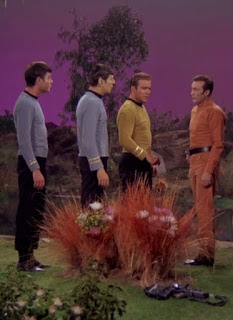
On the topic of wind pollination, By Any Other Name (S2E22) depicts a grass-like species that is—unlike Earth grasses—obviously not wind pollinated. Judging by the size and coloring of the flowers, it is pollinated by an insect or animal. It seems more akin to Earth lilies, which are related to grasses, although its alien foliage seems unmistakably grass (or sedge).

Alien landscape with orange colored grasses

Alien grass with huge flowers

Since nature is a creature of exceptions to rules, not rules, I began to wonder if there are Earth grasses that are insect pollinated. And behold, there are indeed grass species pollinated by insects. See Alex Wild's awesome photo of sideoats grama and insect pollinators below (www.alexanderwild.com).

Sideoats grama and halictid bees

Sideoats grama flowers are stunning, especially when you're the size of a halictid bee!


--------------------------------------
Go to Plants of Star Trek (Part 1)
Go to Plants of Star Trek (Part 3)

08-13-2016—Plants of Star Trek (Part 1)

Star Trek Beyond was released last month, and I went to see it recently. Like Star Trek Into Darkness, Beyond also has an assembly of interesting plant species. It got me reminiscing about the alien landscapes of the original tv show and inspired me to put together a series of posts on the plants of Star Trek.

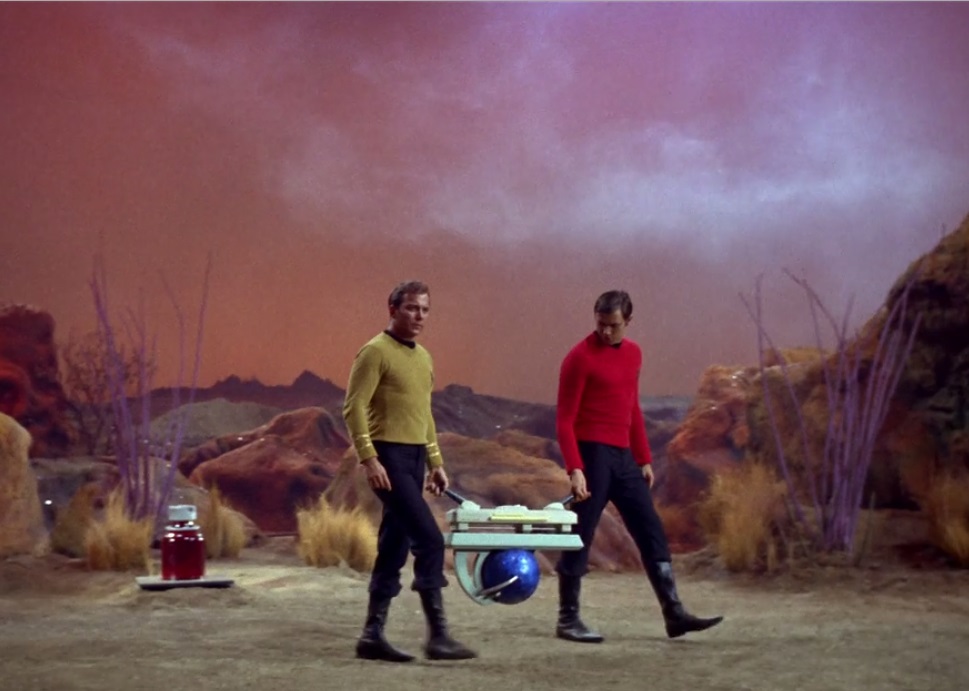
Purple is a dominant color of alien vegetation in the 1960s Star Trek. Set designers applied purple spray paint with abandon, transforming earthbound plants into their xenomorphic equivalents.

Purple colored tumbleweed
S1E1 Pilot: The Cage: Tumbleweed (Salsola sp.) gets the spray can treatment

Mr. Spock with purple twigs in the background
S2E12 The Deadly Years: Not sure what plant these twigs are from, but liberal dose of purple paint applied

Sad purple Joshua tree
S2E13 Obsession: It makes my heart shrivel to see a spray painted Joshua tree (Yucca brevifolia)

Purple ocotillo and Captain Kirk
S2E13 Obsession: More purple desert flora; ocotillo (Fouquieria splendens) is striking in any color

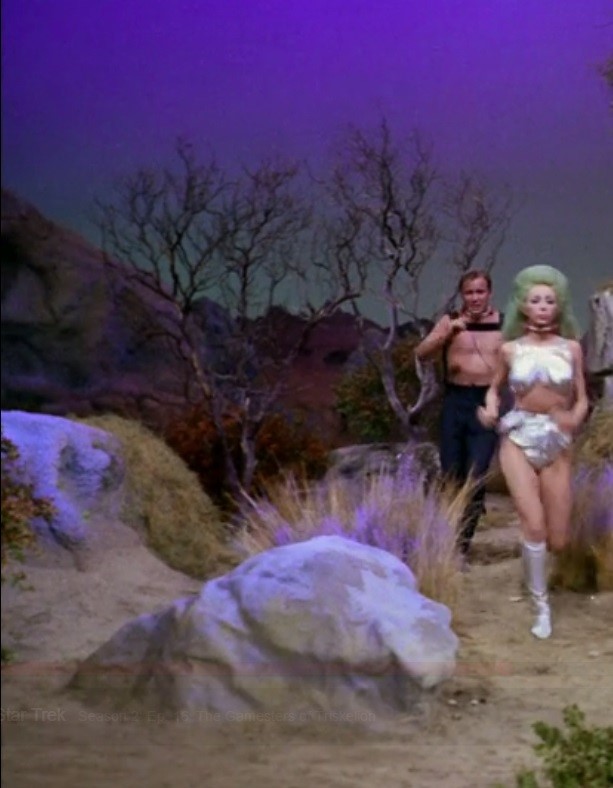
Captain Kirk and Shahna jogging amongst purple grasses
S2E16 The Gamesters of Triskelion: Just out for a jog in the purple grasses; this shot makes me long for a true lavender-colored Earth grass meadow to run through

Whether by accident or not, Star Trek set designers were onto something. Studies of Archaea, an ancient group of microbes, has led to the discovery of photosynthetic retinal pigments that may have predated chlorophyll pigments (Extreme Microbes). Retinal imparts a violet hue to the microorganisms that contain it. Retinal-based primitive microbes might have dominated early Earth, tinting biological hotspots on the planet a distinctive purple color (Purple Earth hypothesis). However, environmental pressures eventually favored the green chlorophyll-containing microbes. Who knows what plants would look like if they had evolved from retinal containing organisms (or if they would exist at all).

Possibly something like this?:
Purple mullet plant
S3E7 Day of the Dove: The alien plant cousin to a mullet—Restio on top, barnacle? on bottom

Purple is also a naturally occurring color in today's Earth plant foliage, although uncommon. Purple leafed plants contain higher concentrations of anthocyanin than chlorophyll. Anthocyanin is not a photosynthetic pigment like retinal, but a flavonoid pigment that carries out other functions (still an active area of research). Anthrocyanins didn't enter the scene until later in plant history, largely after the appearance of seed producing plants (The Evolution of Flavonoids and Their Genes).

Purple leafed plants
Panicum virgatum ‘Cheyenne Sky,’ Tradescantia pallida, Echeveria 'Dark Prince'


--------------------------------------
Go to Plants of Star Trek (Part 2)
Go to Plants of Star Trek (Part 3)